Small-business accounting usually starts as one spreadsheet and stays that way long after it should have grown up. Invoices get tracked in one tab, bank statements get reconciled by hand at month-end, and a bounced cheque means digging through email to figure out what happened.
None of that is a tooling problem you notice day to day — until a client payment goes missing, or closing the books takes a week instead of an afternoon. Sync keeps the whole money trail — invoice to payment to bank line — in one place, so it reconciles itself instead of being reconstructed from memory.
It matters most once the business isn't one set of books — a multi-branch retail chain, a distributor with regional offices, or an agency billing several clients each want their own margin, not one blended number. Sync splits a single shared bank account into a live balance per business unit automatically, instead of a spreadsheet tab per location — and each unit can bank in its own currency if it needs to.
What's included
Invoices
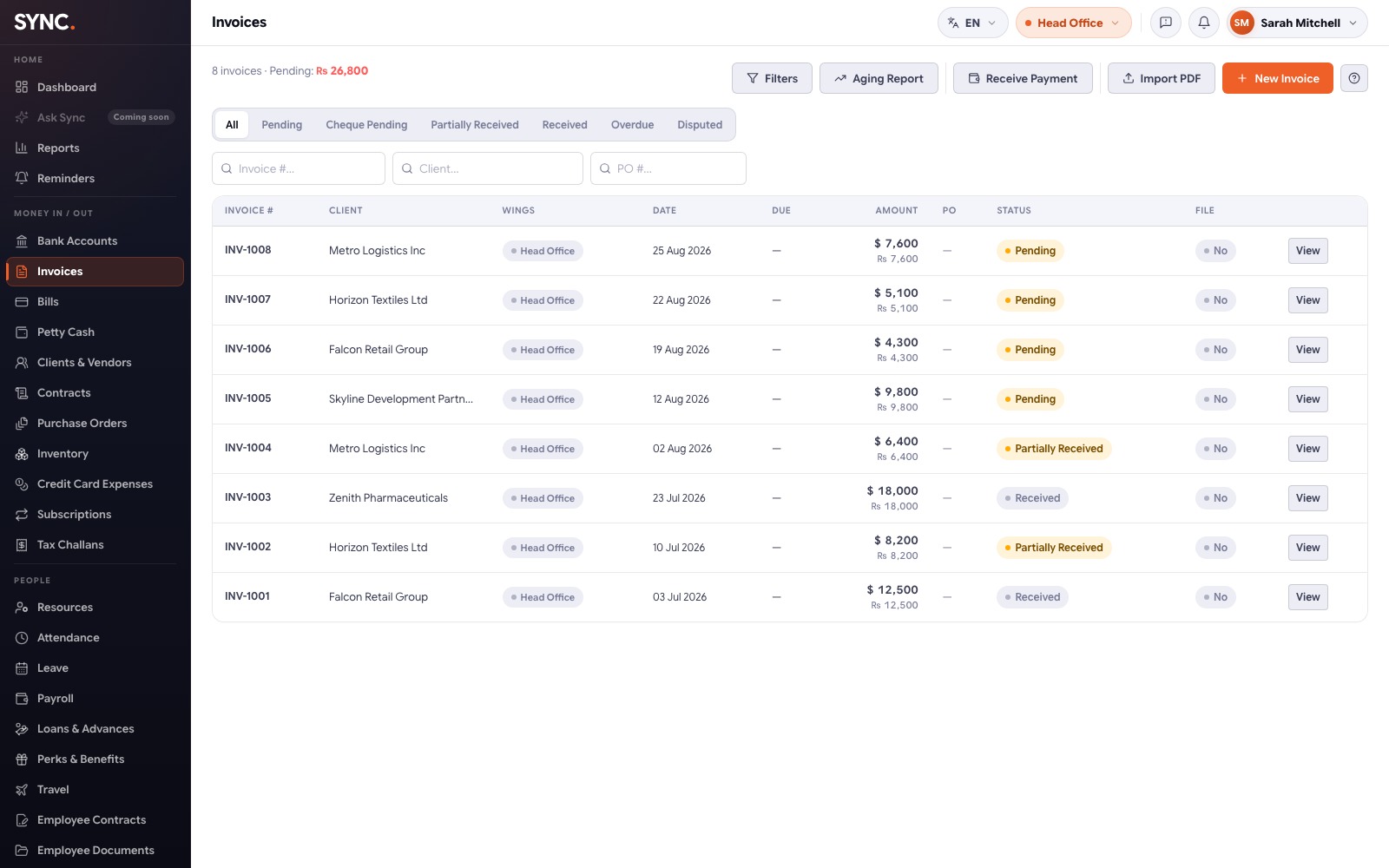
Create, send and track invoices with automatic status — sent, viewed, overdue — instead of chasing payment status manually.
Bank reconciliation
Upload a bank statement and Sync matches it against your recorded transactions automatically, surfacing only the real gaps.
Bills & purchase orders
Track what you owe and what you’ve ordered against what actually arrived, instead of a paper trail split across vendors.
Client payments & cheque tracking
Record partial payments, allocate them across invoices, and track a cheque from received to cleared.
Tax & challans
Keep tax obligations and payment challans attached to the transactions that generated them, not a separate folder.
Petty cash & credit card
Every small cash-drawer expense and card transaction lands in the same ledger as everything else — nothing off the books by accident.
Subscriptions
See every recurring bill the business is on the hook for in one list, before a renewal becomes a surprise line item.
Multi-business accounts
Run several business units on one shared physical bank account, each with its own live balance split automatically — instead of one flat number or a separate account per unit.
Multi-currency
Each bank account, invoice and bill keeps its own currency — a regional office can bill in USD while head office runs in AED. Realized FX gain or loss is tracked automatically, and a cross-currency payment is blocked rather than silently miscalculated.
Financial reports
P&L, Trial Balance, General Ledger and Chart of Accounts, by wing or company-wide, with month-over-month growth analytics — every report filters by date range and exports to PDF or CSV.
How it flows
1
Raise an invoice or record a bill
Tagged to the right client, vendor and business wing from the start — the client's billing details auto-fill from their record.
2
Get paid, or pay
A client payment settles across several open invoices at once; a bill goes out in a single batch with everything else due the same week.
3
Reconcile against the bank statement
Upload the statement and Sync matches it against what was recorded automatically, surfacing only the real gaps before month-end, not during it.
4
Close the month by reading a number
P&L, Trial Balance, General Ledger and wing breakdown are already built — closing is checking a report, not assembling one.
Built for more than one company
Your books stay yours
The business next door could be on Sync too. That's not something you have to take our word on — separation isn't a setting someone can misconfigure, it's how every query is written. Inside your own organization, segregation of duties works the same way: who can act, who can reverse it, and a logged trail of both.
Your data is filtered by organization at the query itself — not hidden in the interface
That scope is read from a signed token, so a request can never ask for another org
Segregation of duties down to the action: raising an invoice, receiving payment on it, and reversing it can each need a different permission
Every reversal or deletion is logged — who did it, when, and what the record said before
An automated suite tries to read across organizations on every release
Uploaded files are stored under your own organization’s path
Org-scopedEvery query filtered by your organization
Token-derivedScope comes from a signed token, never the request
SegregatedAround 50 permissions decide who can act, reverse, or only look
LoggedEvery reversal or deletion recorded with who, when, before and after
Rate-limitedLogin throttled, passwords hashed
Per-wing grantsAccess scoped to a business unit, not just a person
Pricing
One plan. Priced by how many people are on it.
No tiers to compare, no feature you have to upgrade to unlock — every organization gets the whole platform from day one.
15-day free trial · no card required
All-inclusive planEarly bird
$32.50
$25/mo base
Plus $2/mo per person on your team (list price $2.60). Sign up now and this is locked in for as long as you stay subscribed — no other fees, no per-module add-ons.
No — Sync is built for founders and office managers running finance themselves, not accountants using specialized software. Your actual accountant can also get a login with view-only or reporting access if you want a second set of eyes.
How does bank reconciliation work?
Upload your bank statement (CSV or Excel — the column layout is remembered per bank after the first upload) and Sync automatically matches it against your recorded transactions, showing only what’s genuinely missing on either side instead of a full manual comparison.
Can I track multiple bank accounts, or accounts shared across departments?
Yes — accounts can belong to one part of the business or be shared and tagged per-transaction, with a combined view of everything at a single physical bank when you need it.
What happens to my invoice and payment history if I stop using Sync?
Every report exports to CSV or PDF at any time — your financial history isn’t locked into the product.
Can I stop one person from both creating and reversing a payment?
Yes — creating an invoice, receiving payment against it, and reversing a payment are each their own grantable permission, not one blanket "finance access" toggle. Every reversal is logged automatically with who did it and what it said before, so segregation of duties isn't just a policy someone has to remember to follow.
Does this handle more than one currency?
Yes — bank accounts, invoices and bills each keep their own currency, so a regional office can bill in USD while head office runs in AED. Realized FX gain or loss is tracked automatically on foreign invoices, and a payment between mismatched currencies is blocked rather than silently converted at the wrong rate.
Everything in Sync
33 modules. One login. One bill.
Finance, HR and operations under a single roof — so the numbers your team enters once show up everywhere they matter.